Showing posts with label feminism. Show all posts

Monday, July 02, 2012

Who to trust?


It does seem that Slate is right in positing that the GOP believes that "America's Women Can't be Trusted."

I am always, deeply worried about the attempt to pit women against women for political gain. But I think we at least need to be honest about the fact that so many of the current GOP initiatives that seek to free women from the clutches of big government are rooted in the idea that women are systematically trying to cheat the system to get free stuff. You can argue all you want about whether it’s better for women to have access to health care, child care, maternity leave, equal pay, and preventive medicine. But when you base those arguments on rickety old Elizabethan stereotypes about deceitful women and their lying ways, it becomes harder to call yourself the party of women.

[Via Slate]

I always think its an interesting divide. Women have achieved equality in many areas, yet are still framed as 'Daughters of Eve' who seek to game the system.

Preventative medicine is an investment in the future, as it always has been. With the recent passing of Affordable Care Act, I think the conversation will shift to an emphasis on becoming healthier now, so that you save money later. And, that includes women's health care.

Friday, June 08, 2012

Dancing: Games and the Appearance of Effortlessness

I think one of the interesting principles of dance is that: You don't have it down until it looks effortless.

Kyra Gaunt talks about this a bit in her introduction to The Games Black Girls Play, which is an interesting look at the history of African-American women's contributions to music and dance. So, the poly-rhythms that we start learning as children in game settings - how fast can you rhythmically hand clap? - become useful later on in relating music history and social interaction.


Until doing the sequences of double dutch (a particular skill I never mastered) or drumming and dancing simultaneously, appear as though it were effortless, you can't consider the skill mastered. Because studying these rhythms were part of 'play,' outside people consider them to be innate. I spent hours on the playground with Miss Mary Mack, and Down Down Baby, and can play them still with women in previous generations. It belies all of the time and energy I expended into learning and practicing these rhythmic configurations during recess.


In an effort to separate themselves from other dances that have strict competitions and standings, I think that the Lindy Hop community has over-emphasized the idea that anyone can just 'pick this up'. It's not true, for one, and the skills that we use as adults were practiced as children. I can learn how to dance salsa or tango much easier because of my childhood training in ballet and lyrical. And while dance is inherently social, whether you dance solo, in a group or with a partner, it is also one of the earliest forms of storytelling and communication.When I dance, I tell a story with my movements and my body.

The appearance of effortlessness is deceiving, because it does not account for all of the study, training and practice. I have a friend who won the novice ballroom championship this year. People attribute his win to innate talent, which does not account for the weeks that he spent more time analyzing, practicing and training in dance than at his full time job. I can appreciate that. I think it is a false narrative that artistic talent is innate only. It's both innate and the result of skills honed.

When I perform or hit the social floor, you only see the result of study and training, not the time and energy I invested into it. Which is as it should be. I don't want others to watch me learn, I want to work out what I learned. But the learning takes time. I took a private lesson from Dexter back in March, and took notes on the different things that we worked on and ways to improve. Only now in June am I starting to really hone into what he was telling me. It's not that he didn't tell me these things or that I'm an especially slow student; it just took time to translate what he was telling me to how I was moving, and then practice the skill in the correct way.

So, this weekend, I'm excited to test out all these skills on dancers from all over the world. Huzzah!

Tuesday, May 15, 2012

This is Why We Fight

Now, in the land of frightening news:
While the Florida legislature had allocated $1.5 million to 30 rape crisis centers in the state, Gov. Rick Scott used his line-item veto power to cut the funding. The Governor claimed the funding was “duplicative, since, as a state, we already fund sexual violence programs.” But Jennifer Dritt, the executive director of the Florida Council Against Sexual Violence, said individual centers could lose between $30,000 and $100,000 each and don’t have enough funds to serve the 1.2 million women in Florida who “already have been victimized.” 
[Via Feministing.com]

I feel like a lot of people don't realize the magnitude of the problem of sexual assault. Statistically, 1 in 5 women will experience sexual assault at some point in their lives. At least, that's the reported amount. It's within your rights to choose not to report a crime, especially when the justice system is formulated to place the blame on the victim. Yet, these facilities should be available for people to get tested, etc...

I mean we can all agree that violence against women is bad right?  And we can all agree that survivors of domestic abuse need assistance, right?  So why are Republicans opposed to funding that assistance?   Hang ups in this current version of the bill is additional provisions supporting undocumented and LGBT survivors.
[ Via Feministing.com]

 Do we really want perpetrators to believe that it is okay to victimize, as long as the person is undocumented or LGBT? I find this sort of double standard to be very troubling. Undocumented workers in this country already struggle with little protection from the law. Is this the sort of provision that we want to enshrine, a permanent underclass? I should hope not.

Edit: Sadly, related:
 Scholars believe that abuse rates in the ultra-Orthodox world are roughly the same as those in the general population, but for generations, most ultra-Orthodox abuse victims kept silent, fearful of being stigmatized in a culture where the genders are strictly separated and discussion of sex is taboo. When a victim did come forward, it was generally to rabbis and rabbinical courts, which would sometimes investigate the allegations, pledge to monitor the accused, or order payment to a victim, but not refer the matter to the police.

[Via New York Times]

The article continues about the degrees of intimidation experienced by families who speak up about abuse, within the Orthodox Jewish culture. And while I know that the Orthodox Jewish experience is very different from the total Jewish experience, it's still troubling that abuse is not only swept under the rug, the social controls punish the victim.

Sunday, April 08, 2012

The Cost and Care of Essential Femininity

This week, in response to a lot of commotion about women's rights over their reproduction, Jezebel posted an interesting run-down of costs of womanhood. As a counterpart to the men who complain about discounts for female drivers and ladies' nights affording women discounted drinks and club entry, the article noted exactly how much an average woman spends on her fertility.
 Given the national debate regarding birth control coverage, it's increasingly clear that many people have no idea how much it costs it to own a vagina — folks are getting up in arms about the idea that the pill could set uninsured women back about $1000 a year, but in the grand scheme of things, that's nothing. Do you even know just how much you're shelling out for your clam? Were you aware of the fact that in your 20s alone, you will spend over $26,000 on vaginal maintenance? Herewith, we do the math on just how much that cooter is costing you.
[Via Jezebel.com]
It all puts me in mind of the soul song, "A Woman's Worth." I remember getting the talk from mom, and wondering exactly what kind of a raw deal I was signed up for. Headaches and bleeding every month? Crazy hormones? Not even counting all the problems with pregnancy! No wonder it was described as a curse.

While I'm grateful to developments in the paper products industry for freeing us from The Red Tent and using washcloths to stem the tide, we haven't progressed much further from that. Women still have a lot of money to spend on their basic maintenance, excluding the fashion trends that make our clothes go out of style sooner, and the push for a 'serious business woman' to look like a fashion model. One friend was hired for her first real job, and told in the interview, that she needed to spend her first few paychecks on clothes. Not transportation, food, or rent. CLOTHES. 

The Atlantic also notes that women have additional costs, and Jezebel's list is by no means exhaustive:
While Morrissey doesn't note this specifically, such health visits could also include procedures like colposcopies and LEEPs, biopsies of various female parts, and so on—all of which, even if a woman is insured, add up with co-pays and costs beyond what insurance covers.
[Via The Atlantic Wire]

As a recipient of those extra procedures and tests, can I just point out how not having insurance is one of my biggest fears? In fact, after a visit to the doctor lead my common cold to cost as much with insurance as without it (thank you co-pays), the insurance debacle, err... debate is really the one that shapes my generation.

Find a lump, get hit by a bus, sneeze a little too hard, but without insurance you're essentially in a Third World Country. At least there, you'd have chickens to barter with. Maybe a goat if you needed surgery.

Europe is scratching its head over the possibility that the U.S. Supreme Court will strike down President Obama's signature legislative achievement. As the judiciary and the Obama administration trade legal barbs over the high court's authority, the idea that health care coverage, largely considered a universal right in Europe, could be deemed an affront to liberty is baffling.
 [Via The Atlantic Wire]

In a place where I didn't have to worry about filing bankruptcy for health care costs, I'd be more okay with spending a few extra dimes on work clothes. All of this makes me think that a nice Nordic country would be a wonderful place to bear and raise children. Health care, good education and decent holidays? Sign me up!

Saturday, March 17, 2012

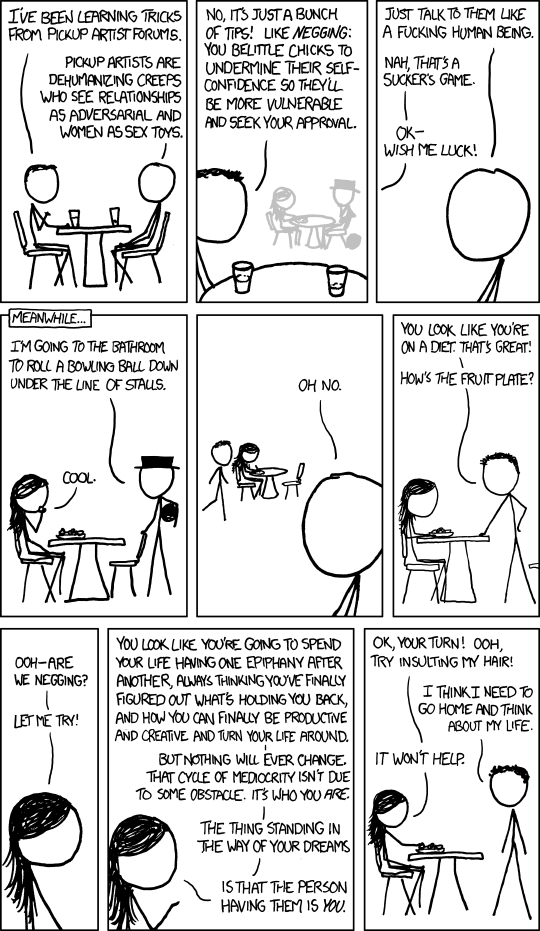
The Neg: Models are People too

[Via xkcd.com]

Ever since The Game sent a press-release copy of their book to my alma mater's gender studies department, I've been intrigued by the whole idea that there are specific tips to be seen as an alpha male to Marialpha females. Moreover, the idea that women who are tired of compliments will respond positively to negs aka, back-handed compliments.

Personally, I don't find myself to be very fond of the idea of being preyed upon by men who have nothing interesting to talk about other than insulting me, but that might just be me.

I had a conversation over the weekend about the whole idea of negging a woman to get her attention. The couple was relaying how they originally met, and how the female was immune to being hit on, so once the guy played it cool and got to know her on a deeper level, she was captivated. One of the listeners took offense to this story, and responded that she and her friends (who were all 10s, according to her) were constantly barraged by men's advances and so she only paid attention to very assertive men. The male of the couple tried to explain that he hadn't done quite the same thing, but she responded to his assertions, calling them negs, when they appeared to be closer to a better grounding for her ego.


The whole incident brings me back to the idea that: Models are people too. In fact, one dear and beautiful friend was verbally assaulted on a movie set, when the director commanded her to take off her clothes, right there in front of everyone. She was an extra, quite literally the low-woman on the totem pole, but she refused. He told her that she wasn't professional and she left the set. As anyone who has worked in the industry knows, any sort of clothing removal would be explicitly negotiated in the contract prior to signing, and future contracts are always negotiated by the agency. What happened in this event was that a director got a big head and decided to verbally abuse an extra. I fully support the film industry, but I do not support this flagrant misuse of an actress.

She's an absolutely beautiful person inside and out, but would never desire to be seen as an object or less of a person. Which is the main point-  that regardless of your exterior beauty, your interior character is the means for which you will be judged.

So many men and women seem to hold models onto a pedestal, as if they can do no evil nor wrong. I find this to be very flawed logic.Perhaps I'm simply too much of a Midwesterner for this, but I was raised that one should be modest about your talents and abilities. If you truly have talent, then people will acknowledge this without your effort. Telling others that you are the simply the best will only lead to resentment. And hubris will only lead to disaster.

Which brings me back to the whole idea of the neg - men seeking to break through a woman's barrier by insulting them. It is so foreign to me.Why would you want a partner that is merely your prey? Why would you pay attention to a man who merely seeks to have you as his trophy for an evening? How is any of this the basis for any sort of a healthy relationship, much less a lasting relationship?

Marilyn Monroe seems to be the current diva-role model, but when I look at how troubled and sad she truly was, I have to wonder if all of the attention only served to dim her light before its time. People have criteria for who they would like to date, but the neg is not the best mating strategy to pursue a partner that you would like to be with for more than one night. It will tarnish your trophy, until the morning light seems to bring everything into a focus too clear for your eyes to stand.

Monday, March 05, 2012

"You can't tell people what they want to hear if you also want to tell the truth"

-Hold Steady, Soft in the Center

James Fallows recently did an excellent piece on President Obama, that explored a lot of the mindset behind much of his decision-making, one of the things that struck me is how miffed people appear to be because he is more reserved.

    It turns out that Obama is sufficiently aware of and sensitive about his Mr. Spock–like image to have called it the “biggest misconception” about him in a year-end interview with Barbara Walters on ABC in December. It was entirely wrong, he said, for the public to think of him as “being detached, or Spock-like, or very analytical. People who know me know that I am a softie. I mean, stuff can choke me up very easily. The challenge for me is that in this job … people want you to be very demonstrative in your emotions. And if you’re not sort of showing it in a very theatrical way, then somehow it doesn’t translate over the screen.”
        Whatever he thinks his real emotional makeup might be, the challenge of “showing it,” and translating it over the screen, affects his ability to lead. As an explainer of ideas through rhetoric, Obama has few recent peers. And at least twice in the past four years, he has changed national opinion, and politically saved himself, through the emotional content of his words and presence. Once was in March 2008, when the media storm about his radical-sounding pastor, Jeremiah “God Damn America!” Wright, threatened to end his candidacy. Then Obama responded with his speech in Philadelphia about the meaning of race in America—which at least for a while, and for at least enough of the electorate to let him survive, made his mixed-race heritage a symbol not of threatening otherness but of the country’s true nature. Then, in January of last year, his party’s historic rout during the midterm elections had made Obama seem as shrunken and defeated a figure as Bill Clinton had seemed after his midterm losses 16 years before. But even his usual opponents hailed Obama’s speech in Tucson after the horrific shooting of Representative Gabby Giffords and others, for its sober but healing emotional power. One conservative blog, Power Line, said it was a “brilliant, spellbinding, and fitting speech”; John Podhoretz, a former speechwriter for Ronald Reagan, wrote in the New York Post that it was “beautiful and moving and powerful.” Politically, this is when Obama seemed to return to life after the midterm disaster.
[Via  The Atlantic, Obama, Explained]

I'm not sure that I entirely buy the idea of Obama as so cold. He has two healthy, loving daughters, and wonderful strong wife, and is the poster-family for the typical American family. No one who is that good with children is a cold person or could be emotionally dead inside. At that point, you'd have marital scandals and rebellious children. Thankfully, this administration has been free of such personal scandals, which is a bit of a relief. It's nice to have a president who is focusing on leading the country in an eloquent and intelligent way, instead of fraught with personal drama.

I also think that this is a catch-22 for the President, similar to the Queen Mother's response to Diana's funeral. Many argued that if she didn't cry, she would be seen as heartless and cold. If she did cry, she would be seen as too weak to be capable of running the country. In the end, her reserved dabbing of tears was seen as the only possible compromise.

But this story from Obama's childhood is very illuminating:

     Over lunch, Barry, who was 9 at the time, sat at the dining table and listened intently but did not speak. When he asked to be excused, Ann directed him to ask the hostess for permission. Permission granted, he got down on the floor and played with Bryant’s son, who was 13 months old. After lunch, the group took a walk, with Barry running ahead. A flock of Indonesian children began lobbing rocks in his direction. They ducked behind a wall and shouted racial epithets. He seemed unfazed, dancing around as though playing dodge ball “with unseen players,” Bryant said. Ann did not react. Assuming she must not have understood the words, Bryant offered to intervene. “No, he’s O.K.,” Ann said. “He’s used to it.”
     “We were floored that she’d bring a half-black child to Indonesia, knowing the disrespect they have for blacks,” Bryant said. At the same time, she admired Ann for teaching her boy to be fearless. A child in Indonesia needed to be raised that way — for self-preservation, Bryant decided. Ann also seemed to be teaching Barry respect. He had all the politeness that Indonesian children displayed toward their parents. He seemed to be learning Indonesian ways.
     “I think this is one reason he’s so halus,” Bryant said of the pres­ident, using the Indonesian adjective that means “polite, refined, or courteous,” referring to qualities some see as distinctively Javanese. “He has the manners of Asians and the ways of Americans — being halus, being patient, calm, a good listener. If you’re not a good listener in Indonesia, you’d better leave.”
 [Via the New York Times, Obama's Young Mother Abroad]

I think it's an important insight of how the qualities generally associated with masculinity (emotionless, strong sturdy oak) are much more constricting than the skills it takes to be a good father and husband, or even the skills that it takes to be a good President. When I envision an ideal President, skills such as intelligence, listening, eloquence and inner strength of character rank higher than those of being buddy-buddy with everyone.

Growing up in a cross-cultural home makes you question if any one system is the correct way of being, especially when it comes to gender roles. Obama's experience in Indonesia undoubtedly shaped his cool, calm and collected personality, but isn't that the sort of person you'd want running the country?

Wednesday, February 29, 2012

Bechdel and women's stories


The above video explains a lot of the still-present under-representation of women in the media, yet one of the questions that has troubled people for a long time is: How do we fix it?

We've known for a long time that film is not the only way women are under-represented, yet it isn't the only media form in which women are seen to be in the minority.

The Atlantic is one of my favorite online news sources, yet, while they have 7 female editors and 9 male editors, even they are not exempt from study.

[via The 2011 Count]

Germany seems to be answering the lack of female representation in their own way: with a truly German quota system. (I do love my German friends, but it is amusing how often we react in very specific cultural ways. You'd never catch a Chilean with a quota system!)

 "Sandberg's key points are that there really is a problem, that it's not because of lack of female potential, and that women need to stop shooting themselves in the foot -- no more drawing back ten years early in anticipation of childbearing, for instance. Equally, though, she lists areas where we, as a society, need to improve. We need more equitable division of labor in the home, for example, if we want to see more equitable division of honors in the boardroom.

Most of Sandberg's musings, however, are cultural, and her calls to action are on an individual level. "I don't have the right answer. I don't even have it for myself," says Sandberg early on, noting that a mother's choices are personal and tricky. "My talk today is about what the messages are if you do want to stay in the workforce."

Right now in Germany, the talk has pole-vaulted over the personal and the cultural to the legal. What Labor Minister Ursula von der Leyen wants, and what she frankly seems pretty frustrated not yet to have gotten, going by her remarks to German television, are legally binding quotas."
 [Via The Atlantic, A German Idea to Break the Corporate Glass Ceiling: Gender Quotas]

The quota system is the response to the low rate of females in the upper levels of finance and media. 

The Atlantic's Heather Horn isn't quite so keen on a similar idea happening in the U.S.

I'm pretty wary of gender quotas for a number of reasons. The principle of equal protection under the law, enshrined in the U.S. in the Fourteenth Amendment, has a lot going for it, and quotas, even when set internally, are one hell of a mess where equal protection is concerned. Though the aim is to correct an injustice, and the assumption is that the highly qualified women who have previously been passed over will now get the jobs they, by merit, deserve, that's not necessarily the way it plays out.

Quotas demand that companies hire female workers whether they're the best hires or not; and, in cases where they're not the best hires, absolutely no one wins. Spare me the argument that it at least accustoms people to having women in charge: a woman in a position she didn't earn builds resentment and only reinforces the nasty assumptions that the hire was supposed to correct in the first place. The answer to unmerited male hires isn't to encourage unmerited female hires.

And let's consider the message that long-term quotas would send. Do we really want a younger generation to get the impression that women need protection from the free market? And even if you buy the current argument for quotas, what does it say that they're being set at 30 percent, rather than 50?
 [Via The Atlantic, What the World Can Learn From Germany's Debate Over Gender Quotas]

 I'm prone to agree with her. I don't want people to assume that the only reason I have my position is because I am the 'diversity hire' instead of the best candidate for the position. I do believe that we should definitely pursue diversity in hiring, especially in the areas of media and professorship.


I think there are many more factors that go into these decisions. Finance is a profession that is often seen as a 70-hour work week, which would prove prohibitive to anyone who might desire a reasonable balance of work-life. From my conversations with female professors, many cited that because they are female, they get swamped with obligations to be the female representative on many boards and associations, and required to do so. Their male colleagues, even those with similar qualifications in the realm of gender studies, are not required to do so. 


I'm also not inclined to believe that simply because a person is of a certain race, sexual orientation or gender, it lessens their voice. I took a sociology course in Diversity and Inequality from a white, heterosexual male professor, but his research and insight into the field of African American Studies and Gender Studies had made him wonderfully insightful.


Rather than quotas, I think that we should focus more on mentoring women in finance, the media, and universities. Have a way for them to see what needs to be done to scale the ladder and networks available for them to do so. We have already made many strides in education, but still have a ways to go. It might not be the sole solution, but its definitely a good way to begin.